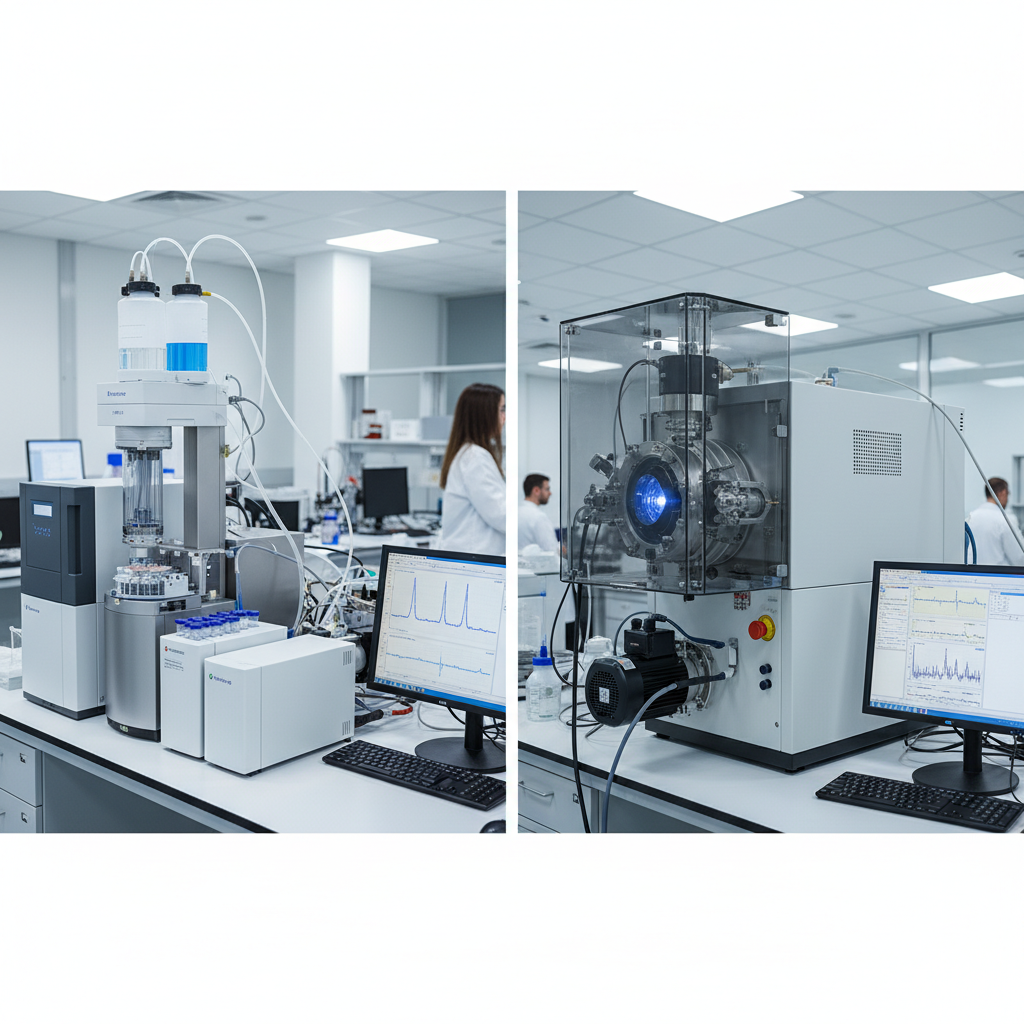
When evaluating research peptide quality, two analytical techniques dominate the conversation: High-Performance Liquid Chromatography (HPLC) and Mass Spectrometry (MS). While both are essential for comprehensive quality assessment, they measure fundamentally different things. Understanding the distinction is critical for researchers evaluating vendor quality claims.
HPLC: Measuring Purity
How HPLC Works
High-Performance Liquid Chromatography separates the components of a mixture based on their physicochemical properties. For peptides, reverse-phase HPLC (RP-HPLC) is the standard method:
- The peptide sample is dissolved and injected into a column packed with C18-bonded silica particles
- A gradient of increasing organic solvent (typically acetonitrile with TFA) flows through the column
- Different components separate based on their hydrophobicity — they interact differently with the stationary phase
- A UV detector (typically at 214nm or 220nm wavelength) measures each component as it elutes
- The resulting chromatogram shows peaks corresponding to each separated component
Interpreting HPLC Results
The purity percentage is calculated by comparing the area of the main product peak to the total area of all detected peaks:
Purity (%) = (Main peak area / Total peak area) x 100
Key points for interpretation:
- >98% purity: Excellent, research-grade quality
- 95-98% purity: Good quality, acceptable for most research applications
- 90-95% purity: Moderate quality, may contain significant impurities
- <90% purity: Low quality, impurities may interfere with research results
What HPLC Cannot Tell You
HPLC measures purity but does not definitively confirm identity. A chromatogram showing 99% purity means 99% of the detected material is one compound — but HPLC alone cannot confirm that compound is the intended peptide. This is where mass spectrometry becomes essential.
Common HPLC Impurities in Peptides
- Deletion sequences: Peptides missing one or more amino acids from incomplete coupling reactions
- Truncated sequences: Shorter fragments from premature chain termination
- Oxidized forms: Methionine or tryptophan oxidation products
- Deamidation products: Asparagine or glutamine side chain modifications
- TFA/Acetate salts: Counter ions that affect peptide content but not purity per se
Mass Spectrometry: Confirming Identity
How Mass Spectrometry Works
Mass spectrometry measures the mass-to-charge ratio (m/z) of ionized molecules:
- The peptide is ionized (typically by ESI — Electrospray Ionization)
- Ions are separated by their mass-to-charge ratio in a mass analyzer
- A detector records the signal intensity at each m/z value
- The resulting mass spectrum shows peaks at specific m/z values
Types of Mass Spectrometry for Peptides
ESI-MS (Electrospray Ionization)
- Most common for peptide analysis
- Produces multiply charged ions (z = +2, +3, +4, etc.)
- Excellent for peptides in the 500-5000 Da range
- Can be coupled directly to HPLC (LC-MS)
MALDI-TOF (Matrix-Assisted Laser Desorption/Ionization — Time of Flight)
- Produces primarily singly charged ions
- Better for larger peptides and proteins
- Higher tolerance for salts and contaminants
- Faster analysis but less quantitative
Interpreting Mass Spec Results
The observed molecular mass should match the theoretical mass calculated from the amino acid sequence:
- Mass accuracy within 0.01%: Excellent confirmation of identity
- Mass accuracy within 0.1%: Acceptable for routine quality control
- Mass deviation >0.1%: May indicate wrong peptide, modifications, or adducts
What Mass Spec Cannot Tell You
Mass spectrometry confirms molecular identity but provides limited information about:
- Purity (how much of the sample is the correct peptide vs. impurities)
- Stereochemistry (D vs. L amino acid substitutions have the same mass)
- Peptide content (the percentage of actual peptide in the lyophilized powder)
HPLC + MS: The Complete Picture
The combination of HPLC and MS provides comprehensive quality assessment:
| Metric | HPLC | Mass Spec |
|---|---|---|
| Purity quantification | Yes | Limited |
| Identity confirmation | Limited | Yes |
| Impurity profiling | Yes | Yes (with LC-MS) |
| Structural information | No | Yes |
| Quantitative | Yes | Semi-quantitative |
LC-MS: The Best of Both Worlds
Liquid Chromatography-Mass Spectrometry (LC-MS) combines both techniques in a single analysis. The HPLC separation feeds directly into the mass spectrometer, allowing simultaneous purity assessment and identity confirmation of every detected peak. This is the gold standard for peptide quality analysis.
What to Look for from Vendors
When evaluating vendor quality claims, look for:
- Both HPLC and MS data: A purity claim supported only by HPLC lacks identity confirmation. An MS result without HPLC lacks purity data.
- Actual chromatograms and spectra: Not just numbers, but the raw analytical data.
- Third-party testing: Independent laboratory results are more reliable than in-house testing.
- Batch-specific results: COAs should reference specific lot numbers, not generic product data.
- Method details: Professional COAs describe the analytical methods used.
Advanced Testing Methods
Beyond standard HPLC and MS, some vendors provide additional testing:
- Amino Acid Analysis (AAA): Hydrolyzes the peptide and quantifies each amino acid to confirm sequence composition
- Peptide Content Analysis: Determines the actual peptide mass fraction (accounting for moisture, salts, and counter ions)
- Endotoxin Testing (LAL): Measures bacterial endotoxin levels, critical for injectable preparations
- HPLC-MS/MS (Tandem MS): Provides sequence-level confirmation through peptide fragmentation
Conclusion
Neither HPLC nor mass spectrometry alone provides a complete picture of peptide quality. HPLC answers "how pure is it?" while mass spectrometry answers "is it the right molecule?" Together, they form the foundation of reliable peptide quality assessment. When evaluating vendors, prioritize those who provide both types of data from independent, accredited laboratories.
This article is for educational purposes related to analytical chemistry and research chemical quality assessment. All peptides discussed are for laboratory research use only.