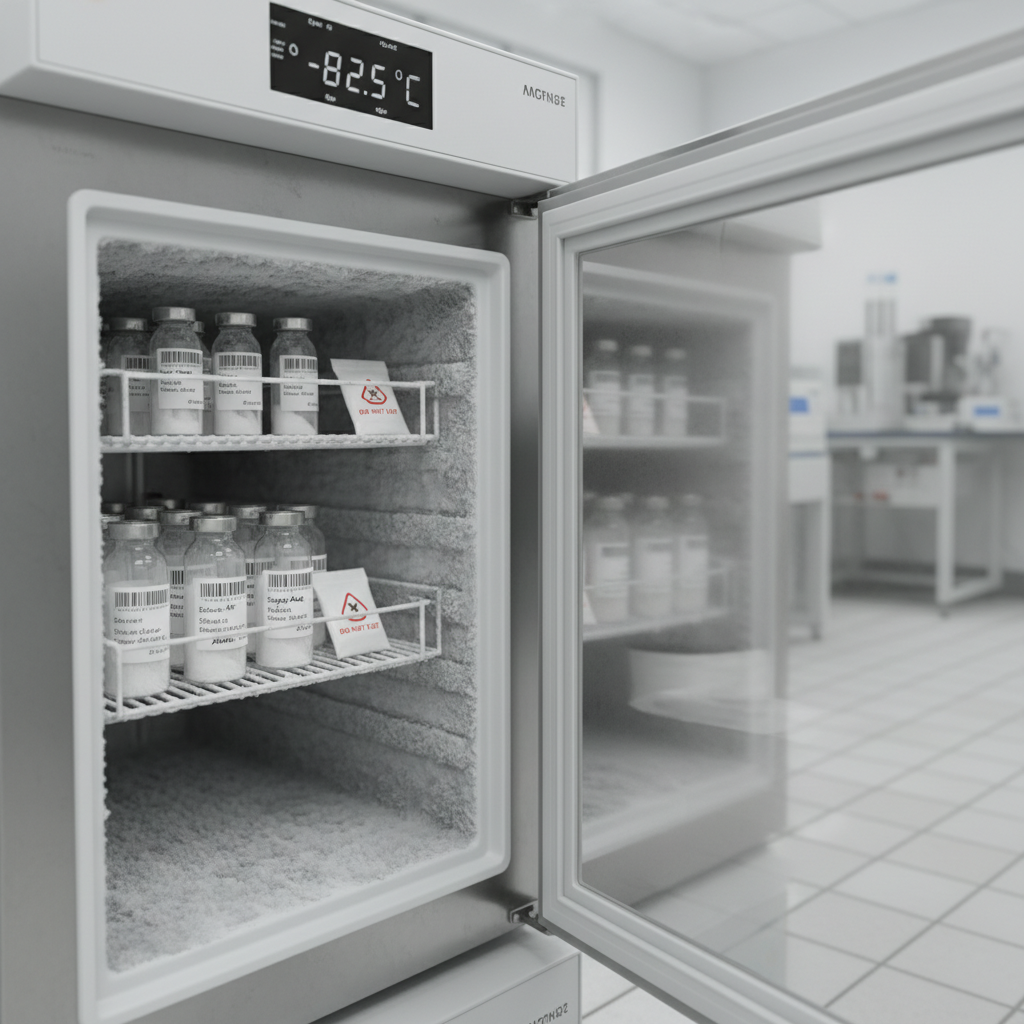
Research peptides are sensitive biological molecules that require proper storage and handling to maintain their integrity and activity. Improper handling is one of the most common reasons for inconsistent research results when working with peptides. This guide covers best practices for every stage of peptide handling in the laboratory.
Lyophilized (Powder) Storage
Lyophilized (freeze-dried) peptides are the most stable form and should be maintained in this state until ready for use.
Temperature Requirements
- Long-term storage (months to years): -20C to -80C freezer
- Medium-term storage (weeks to months): -20C freezer
- Short-term storage (days to weeks): 2-8C refrigerator (for stable peptides only)
- Room temperature: Avoid for any extended period
Storage Best Practices
- Keep sealed: Leave vials sealed with the manufacturer's cap until ready for reconstitution. The seal protects against moisture absorption, which is one of the primary degradation pathways for lyophilized peptides.
- Use desiccant: Store vials with desiccant packets to absorb any residual moisture. Silica gel packets are standard.
- Protect from light: Many peptides contain light-sensitive amino acids (tryptophan, tyrosine). Store in original packaging or wrap vials in aluminum foil.
- Minimize freeze-thaw cycles: If you need to access a storage freezer frequently, consider keeping peptide stocks in a separate, less frequently opened freezer.
- Document storage conditions: Maintain a log of storage temperatures and any temperature excursions.
Stability by Peptide Type
- Most stable: Small peptides without methionine, cysteine, or tryptophan residues (e.g., KPV, BPC-157)
- Moderately stable: Most standard peptides including Ipamorelin, CJC-1295
- Least stable: Peptides containing methionine (oxidation-sensitive), cysteine (disulfide formation), or multiple tryptophan residues
Reconstitution Protocols
Choosing a Solvent
| Solvent | Use Case | Sterility | Shelf Life |
|---|---|---|---|
| Sterile Water | Short-term use, most peptides | Sterile, no preservative | Use within 24-48 hours |
| Bacteriostatic Water (BAC water) | Standard reconstitution | Contains 0.9% benzyl alcohol preservative | 14-28 days refrigerated |
| Acetic Acid (0.1%) | Poorly soluble peptides | Must be prepared sterile | Peptide-dependent |
| PBS Buffer | pH-sensitive peptides | Available sterile | 7-14 days refrigerated |
| DMSO | Very hydrophobic peptides | Must be molecular biology grade | Variable |
Step-by-Step Reconstitution
- Allow the vial to reach room temperature (15-20 minutes) before opening. Opening a cold vial allows moisture condensation on the peptide.
- Prepare your workspace: Work in a clean environment. Use a laminar flow hood if available for injectable research preparations.
- Clean the vial stopper with an alcohol swab and allow to dry completely.
- Calculate the desired concentration. For example, to make a 5mg/mL solution from a 5mg vial, add 1mL of solvent.
- Add solvent slowly by directing the stream against the inside wall of the vial, not directly onto the peptide cake. This prevents the peptide from being blown around the vial.
- Do NOT shake or vortex the vial. Instead, gently swirl or roll the vial between your palms. Vigorous agitation can denature peptides through mechanical stress and foaming.
- Allow time for complete dissolution. Most peptides dissolve within 5-10 minutes. Some may require up to 30 minutes. The solution should be clear and free of visible particles.
- If the peptide does not dissolve: Add a small amount (10-20%) of acetic acid or DMSO to improve solubility, then dilute with your primary solvent.
Common Reconstitution Mistakes
- Using too little solvent: Overly concentrated solutions may not fully dissolve and can precipitate upon storage
- Injecting solvent too forcefully: Can blow lyophilized powder around the vial, leading to loss
- Vortexing or shaking vigorously: Can cause aggregation, denaturation, or foaming
- Not allowing the vial to warm up first: Cold reconstitution can reduce solubility and cause moisture issues
- Using expired or contaminated solvents: Always check solvent expiration dates and sterility
Reconstituted Peptide Storage
General Guidelines
- Refrigerate immediately: Store reconstituted peptides at 2-8C
- Use within the recommended timeframe: Typically 14-28 days for BAC water reconstitution
- Protect from light: Keep in original vial or wrap in foil
- Minimize needle punctures: Each puncture introduces potential contamination. Use proper aseptic technique.
- Never refreeze a reconstituted peptide solution (unless specifically validated for your peptide and concentration)
Signs of Degradation
- Cloudiness or turbidity in a previously clear solution
- Visible particles or precipitate formation
- Color change from the original clear/colorless appearance
- Unusual odor (most peptide solutions are odorless)
- Loss of activity in research assays at expected concentrations
Special Considerations by Peptide
BPC-157
- Relatively stable peptide
- Reconstitutes easily in BAC water
- Stable at 4C for 14-21 days
GHK-Cu
- Blue-green color is normal (copper complex)
- Light-sensitive — always protect from light
- Reconstitute in sterile water, avoid buffers that may chelate copper
- Stable at 4C for 7-10 days
MOTS-c / SS-31
- Contains methionine — oxidation-sensitive
- Use deoxygenated solvents if possible
- Shorter reconstituted shelf life (7 days)
- Consider aliquoting into single-use portions
CJC-1295 / Ipamorelin
- Standard reconstitution in BAC water
- Relatively stable reconstituted (14-21 days at 4C)
- For combination research, reconstitute separately
Epitalon
- Standard reconstitution in sterile water or BAC water
- Stable peptide with good shelf life
- Protect from light
Aliquoting for Long-Term Research
For peptides that will be used over an extended period:
- Reconstitute the full vial at your desired concentration
- Divide into single-use aliquots using sterile microcentrifuge tubes
- Flash-freeze aliquots in liquid nitrogen or dry ice
- Store at -20C or -80C
- Thaw one aliquot per use — never refreeze
This approach minimizes degradation from repeated freeze-thaw cycles and reduces contamination risk from multiple needle punctures.
Equipment Recommendations
- Insulin syringes (29-31 gauge): For precise volume measurement and reconstitution
- Alcohol swabs: For cleaning vial stoppers
- Desiccant packets: For moisture protection in storage
- Aluminum foil: For light-sensitive peptide protection
- Sterile microcentrifuge tubes: For aliquoting
- Calibrated pipettes: For precise volume transfers in research applications
- Temperature monitoring: Digital thermometer or temperature logger for storage verification
Conclusion
Proper peptide handling is not complicated, but it requires attention to detail and consistent technique. The difference between reliable and unreliable research results often comes down to how well the peptides were stored and handled before use. By following these protocols, researchers can maximize the useful life and maintain the integrity of their research peptide stocks.
This guide is for laboratory research purposes only. All peptides discussed are for research use only and are not intended for human consumption.