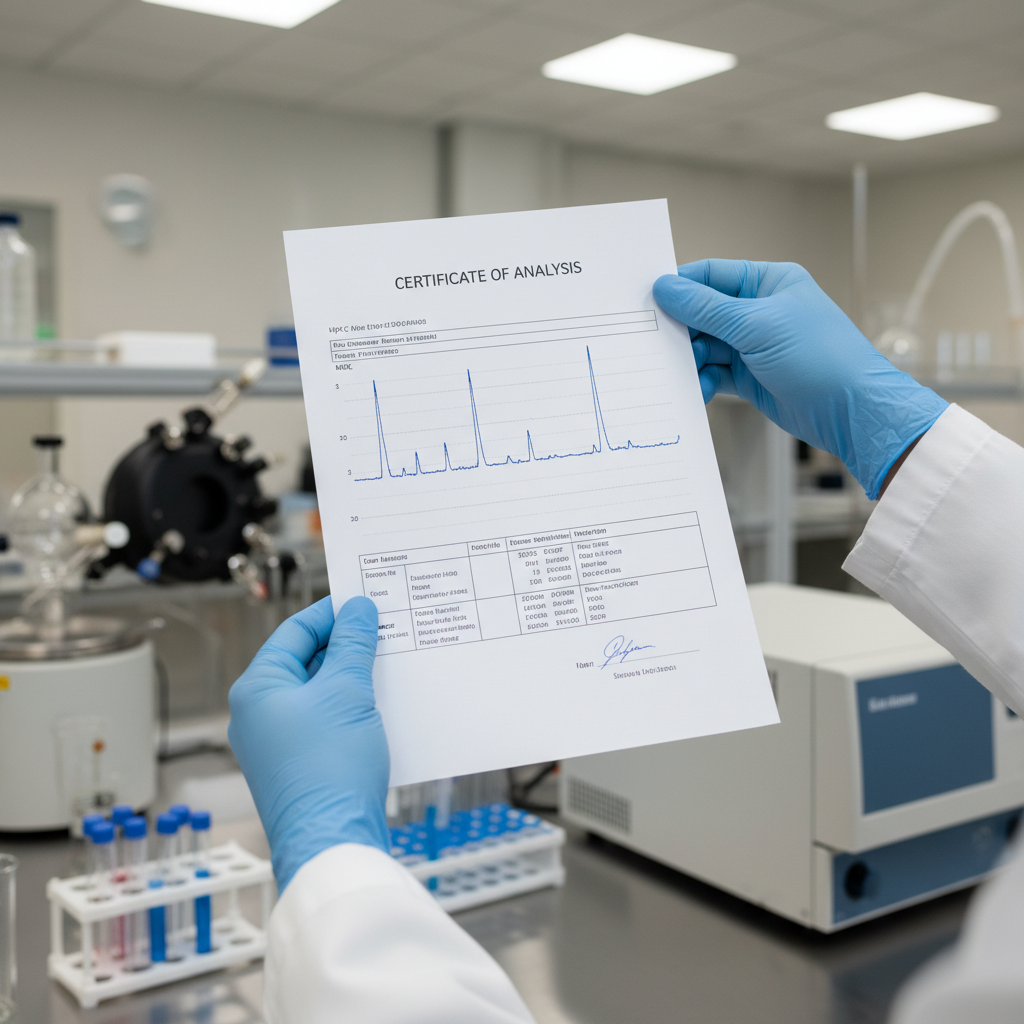
A Certificate of Analysis (COA) is the single most important document when evaluating research peptide quality. It provides objective, laboratory-generated data about the identity, purity, and quality of a specific batch of peptide. Understanding how to read and evaluate a COA is essential for any researcher working with synthetic peptides.
What is a Certificate of Analysis?
A COA is a document issued by a testing laboratory that certifies the results of analytical testing performed on a specific batch of product. For research peptides, a COA typically includes identity confirmation, purity assessment, and various quality metrics. The most credible COAs come from independent third-party laboratories rather than in-house testing by the vendor.
Key Components of a Peptide COA
1. Product Identification
The top of any COA should clearly identify:
- Product name and catalog number
- Batch/Lot number — this should match the label on your product
- Molecular formula and molecular weight
- CAS number (if applicable)
- Date of testing and date of manufacture
If any of these are missing, it raises questions about the document's legitimacy.
2. HPLC Purity Analysis
High-Performance Liquid Chromatography (HPLC) is the gold standard for peptide purity testing. On the COA, look for:
- Purity percentage: Research-grade peptides should show 95% or higher. Premium vendors typically achieve 98-99%+ purity.
- Method details: The COA should specify the HPLC method used (column type, mobile phase, gradient conditions). Common methods include C18 reverse-phase HPLC.
- Chromatogram: A quality COA includes the actual HPLC chromatogram — a graph showing peaks. The main product peak should be dominant with minimal impurity peaks.
- Retention time: The time at which the peptide elutes from the column. This should be consistent with the expected value for that specific peptide.
3. Mass Spectrometry (MS) Data
Mass spectrometry confirms the identity of the peptide by measuring its molecular mass:
- Observed mass: Should match the theoretical molecular weight within acceptable error margins (typically within 0.1% for ESI-MS).
- Mass spectrum: Shows the mass-to-charge ratio (m/z) peaks. The dominant peak should correspond to the expected molecular ion.
- Ionization method: Common methods include ESI (Electrospray Ionization) and MALDI (Matrix-Assisted Laser Desorption/Ionization).
4. Additional Testing
Premium COAs may include:
- Amino acid analysis: Confirms the amino acid composition matches the expected sequence
- Peptide content: The actual peptide percentage in the lyophilized powder (accounting for counter ions, moisture, and salts) — typically 70-85% for acetate salts
- Endotoxin testing: Important for injectable research preparations, measured in EU/mg
- Sterility testing: Confirms absence of microbial contamination
- Appearance and solubility: Physical characteristics of the peptide
Red Flags on a COA
Watch out for these warning signs:
- No batch/lot number: Every legitimate COA must reference a specific batch
- Generic or templated appearance: COAs that look identical across different products or batches
- Missing chromatogram: A purity claim without supporting HPLC data is meaningless
- Round numbers only: Real analytical results rarely produce exactly 99.0% purity — look for precise decimals like 98.73%
- No laboratory identification: The testing lab should be named, ideally with accreditation information
- Dates that don't align: Testing dates should be recent relative to the product manufacture date
- No analyst signature or approval: Quality COAs include reviewer/analyst sign-off
Third-Party vs. In-House Testing
Third-party testing (performed by an independent laboratory) is generally more trustworthy than in-house testing because:
- Independent labs have no financial incentive to produce favorable results
- They are subject to their own quality management systems and accreditations
- Results can theoretically be verified by contacting the lab directly
- ISO 17025 accredited labs follow internationally recognized testing standards
How to Verify a COA
- Check the lab name: Search for the testing laboratory online. It should be a real, established entity.
- Look for accreditation: ISO 17025 or similar accreditation indicates adherence to quality standards.
- Match batch numbers: The COA batch number must match the batch number on your product vial.
- Cross-reference data: If you have access to analytical equipment, you can verify the identity independently using mass spectrometry.
- Contact the vendor: Reputable vendors will readily provide COAs upon request and can connect you with the testing laboratory.
Conclusion
A COA is only as valuable as your ability to interpret it. By understanding what each component means and knowing what red flags to look for, you can make more informed decisions about research peptide quality. Always prioritize vendors who provide comprehensive, third-party COAs with full analytical data for every batch.
This article is for educational purposes related to research chemical quality assessment. All peptides discussed are for laboratory research use only and are not intended for human consumption.