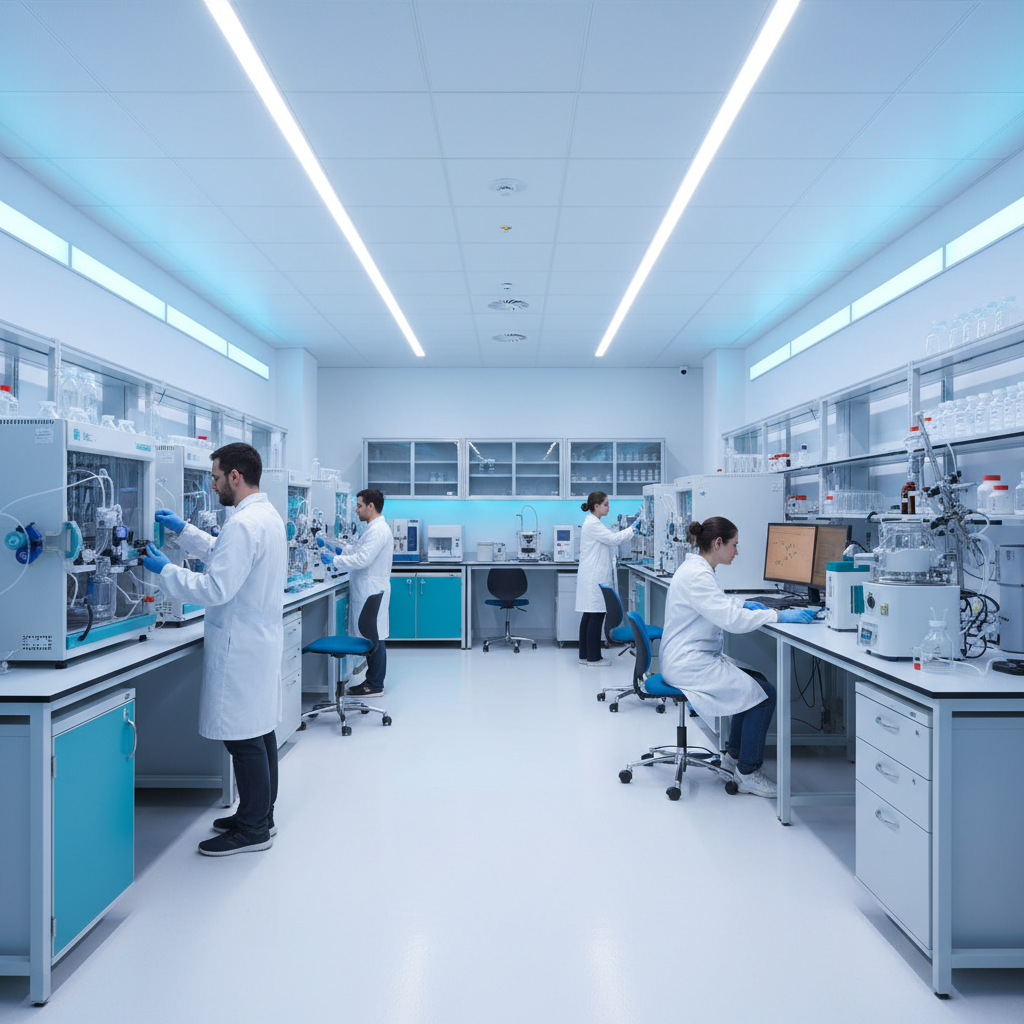
COA testing is the lab work that produces a certificate of analysis. A sample from one production lot goes to a lab, the lab runs a defined set of tests, and the results are written up on a report tied to that lot number. For a research peptide, the core tests are HPLC for purity and mass spectrometry for identity. Fuller panels add content per vial, water, counterions, endotoxin, sterility and heavy metals. A COA is only as strong as the tests listed on it, so the first thing to check on any report is which of these were actually run.
This guide covers the testing side. For what a COA is and how to obtain one, see our article "What Is a COA? Certificate of Analysis Meaning, Example and How to Get One". For a line-by-line walkthrough of a finished report, see "How to Read a Certificate of Analysis (COA)".
What COA Testing Covers: The Short Version
| Test | Question it answers | Common method | Reference standard |
|---|---|---|---|
| Purity | What share of the peptide material is the target sequence? | Reversed-phase HPLC with UV detection | Lab method, often USP general chapters for chromatography |
| Identity | Is it the right molecule? | Mass spectrometry (ESI or MALDI), or LC-MS | Lab method |
| Content (quantity) | How much peptide is in the vial? | HPLC against a reference standard, amino acid analysis, or nitrogen analysis | Lab method |
| Water | How much moisture does the powder hold? | Karl Fischer titration | USP chapter 921 |
| Counterions | How much TFA or acetate salt is present? | Ion chromatography or NMR | Lab method |
| Endotoxin | Are bacterial endotoxins present? | LAL (Limulus amebocyte lysate) assay | USP chapter 85 |
| Sterility | Is there viable microbial growth? | Culture in growth media | USP chapter 71 |
| Heavy metals | Are elemental impurities present? | ICP-MS | USP chapters 232 and 233, ICH Q3D |
| Residual solvents | Are synthesis solvents left over? | Gas chromatography | USP chapter 467 |
Most research peptide COAs show the first two rows. Some show the third. The rest appear only on fuller panels, usually when a vendor or buyer pays for them separately.
Purity Testing: HPLC
High-performance liquid chromatography separates the components of a sample as they pass through a column. Peptides are usually detected by UV absorbance around 214 to 220 nm, where the peptide bond absorbs. The report shows a chromatogram, a trace with one large main peak and smaller impurity peaks, and the purity figure is the main peak's area as a share of all detected peak area.
What the purity number tells you:
- How clean the peptide fraction is. A 99% result means the main peak makes up 99% of the UV-detected material.
- Nothing about salts or water. Counterions and moisture are mostly invisible at that wavelength, so they do not lower the purity figure.
- Nothing on its own about identity. If the wrong peptide were synthesized cleanly, it would still show one tall peak.
Some labs also use HPLC for identity, by matching the main peak's retention time to a reference standard run on the same method. That is a real test, but weaker than a mass result. The Core Peptides report we describe in "Is Core Peptides Legit?" is an example: identity by HPLC retention time, no mass spectrometry.
Identity Testing: Mass Spectrometry
Mass spectrometry measures the molecular mass of what is in the sample. The lab compares the observed mass to the theoretical mass of the sequence. A match within the method's tolerance confirms the molecule is what the label says. LC-MS combines both steps, separating the sample by chromatography and then measuring the mass of each peak, so impurities can be identified as well as counted.
A report should show the expected mass, the observed mass and ideally the spectrum. A line reading only "conforms" with no numbers gives you less to check. Our article "Understanding Peptide Purity: HPLC vs Mass Spectrometry" covers the two methods in detail.
Content Testing: How Much Peptide Is in the Vial
Purity and quantity are separate results. A vial labeled 5 mg can hold a 99% pure peptide and still contain less or more than 5 mg of it.
There are two different content figures, and they are often confused:
- Quantity per vial. The lab measures the milligrams of target peptide in the vial, usually by HPLC against a reference standard. Independent tester Finnrick, for example, grades vendors on both purity and labeled quantity.
- Net peptide content. This is the share of the powder's weight that is peptide rather than counterions and water. Bachem, one of the largest peptide manufacturers, says in its handling guidance that research peptides often exceed 95% HPLC purity while net peptide content can fall between 70 and 90%. It notes this can be measured by amino acid analysis or by elemental nitrogen analysis, since counterions and water contain no nitrogen.
If a report shows no content figure at all, the vial's fill weight has not been checked by that report.
Water and Counterion Testing
Lyophilized peptides absorb moisture, and most synthetic peptides are isolated as salts, commonly trifluoroacetate (TFA) from HPLC purification or acetate after a salt exchange. Karl Fischer titration, described in USP chapter 921, measures water content. Ion chromatography or NMR measures the counterion. These results explain the gap between gross powder weight and net peptide content, and they matter for assays where TFA can interfere with cell work. Our article "Understanding Peptide Sequences and Amino Acid Nomenclature" explains how salt forms change molecular weight.
Safety Panel: Endotoxin, Sterility, Metals and Solvents
These tests come from pharmaceutical quality control and appear on a minority of research peptide COAs:
- Endotoxin (USP chapter 85). The LAL assay detects lipopolysaccharide from gram-negative bacteria and reports it in endotoxin units (EU). It matters for cell culture and animal model work, where endotoxin can trigger an immune response that confounds results.
- Sterility (USP chapter 71). The sample is cultured in growth media and watched for microbial growth. The chapter calls for an incubation period of at least 14 days, so sterility results take much longer than an HPLC run.
- Elemental impurities (USP chapters 232 and 233). ICP-MS screens for metals such as lead, arsenic, cadmium and mercury, using limits set out in USP and the ICH Q3D guideline.
- Residual solvents (USP chapter 467). Gas chromatography checks for solvents left from synthesis and purification.
A full safety panel costs more and takes longer than purity and identity alone, which is why most vendors post it for selected batches rather than every product, if at all.
In-House vs Third-Party COA Testing
A COA can come from the manufacturer's own lab or from an independent lab. Independent labs have no stake in the result, and the strongest reports name an ISO/IEC 17025 accredited lab and give the accreditation certificate number, so the lab's scope can be looked up in the A2LA or ANAB directory. Accreditation covers specific test methods, not the lab as a whole.
Among the vendors this site reviews, published reports name different labs. Swiss Chems names Janoshik Analytical in its FAQ as its main testing lab. Ascension Peptides posts reports from MZ Biolabs and Kovera Labs. Core Peptides posts reports from Vanguard Laboratory, which cites A2LA certificate 6377.01.01. Our articles "Is Swiss Chems Legit?", "Is Ascension Peptides Legit?" and "Is Core Peptides Legit?" describe what those reports include, and "Third-Party Testing: Why Independent Lab Verification Matters" explains how to check a lab's accreditation scope.
One limit applies to almost every submitted-sample report: the lab tests what it receives. Vanguard's footer, for example, says the lab did not take part in sample selection and cannot confirm the sample represents the whole batch. A COA describes one sample from a lot, not every vial.
How Lab Analysis of a Research Peptide Is Ordered
Researchers and vendors use the same basic process to have a sample analyzed:
- Choose the panel. Purity and identity is the usual starting point. Add quantity if the fill weight matters, and endotoxin if the material goes into cell or animal work.
- Submit the sample. Most labs take an order online, then ask for the sealed vial with the product name, labeled amount and lot number.
- Wait for results. HPLC and MS results typically come back within days. Sterility takes weeks because of incubation.
- Receive the report. Many labs issue a report with a unique number or verification key so a third party can confirm it on the lab's own site.
Prices and turnaround times change often and differ by lab and panel, so check the lab's current price page rather than relying on figures quoted elsewhere.
What "COA Verified" Means
"COA verified" is used in two different ways, and neither means the same thing as a full test panel:
- On a vendor's site, it usually means the vendor publishes a COA for the product. Check whether the report is for your lot, names an outside lab and lists the tests above.
- On a review site, including the "COA Verified" label on our vendor pages, it describes the vendor's documentation: that batch-level certificates are published and can be read and matched to a lot. It is not a lab test performed by the review site.
A meaningful check of any COA has four parts. The lot number on the report matches the vial. The lab is named and its report can be confirmed on the lab's site. The test list includes at least purity and mass identity. The lab's accreditation covers the methods used.
Frequently Asked Questions
Is COA testing required for research peptides?
There is no single legal requirement that applies to every research chemical sale. Pharmaceutical manufacturers test each batch under current good manufacturing practice rules. Research-use suppliers publish COAs voluntarily, which is why the depth of testing varies so much between vendors.
Which COA tests matter most?
Purity by HPLC and identity by mass spectrometry are the minimum. Quantity per vial is the next most useful, because purity says nothing about how much material is in the vial.
Can a high purity result hide a problem?
Yes. HPLC purity does not measure water, salts, endotoxin, metals or fill weight, and it does not prove identity on its own. A 99% result is one line of a report, not the whole report.
How often should a vendor test?
Each production lot should have its own report. A single COA reused across many lots or years does not describe the material in a new vial.
This article is for educational purposes and describes analytical methods and information published by vendors, laboratories and public sources as of November 2026. All compounds discussed are for laboratory research use only and are not intended for human consumption.