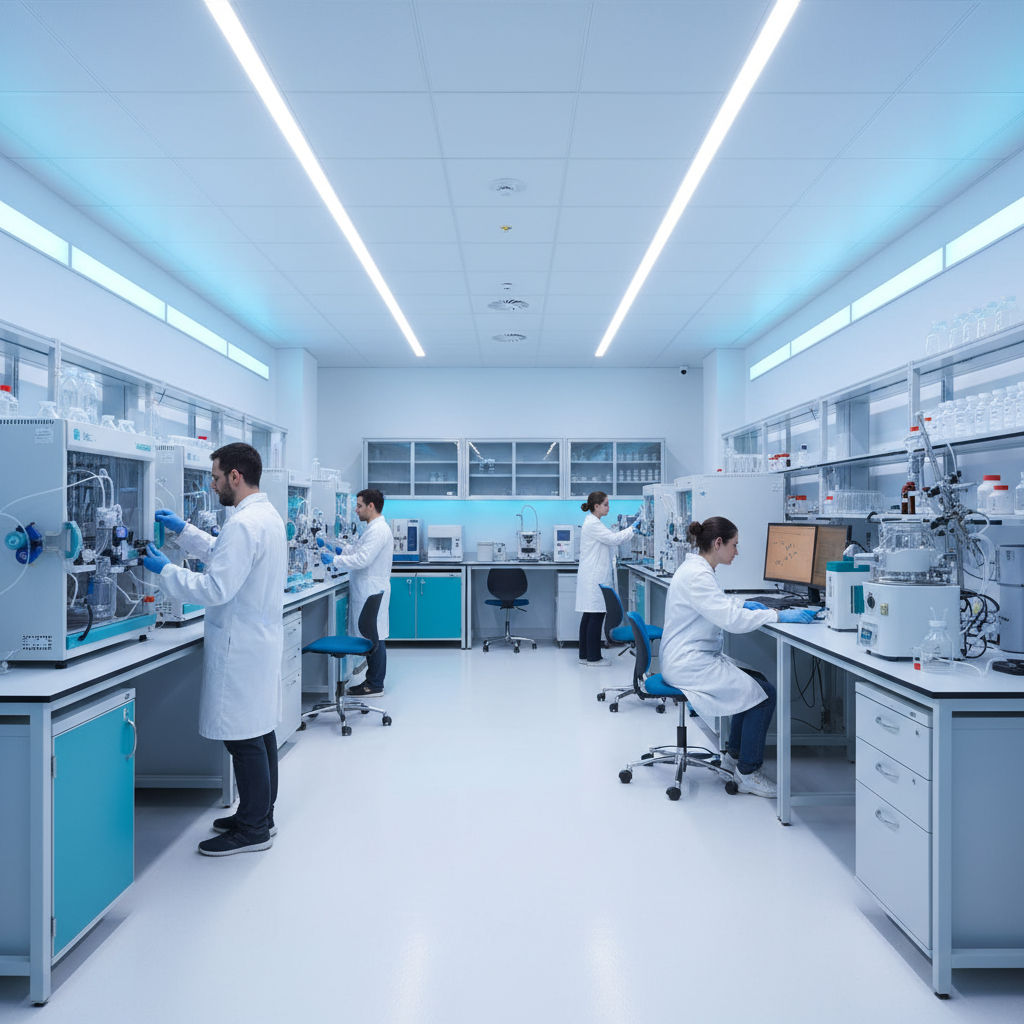
One of the most common questions in peptide research is whether to reconstitute lyophilized peptides in bacteriostatic water (BAC water) or sterile water for injection. While both are widely used, they have distinct properties that make each better suited to different research applications. This article provides a comprehensive comparison to help researchers make informed solvent choices.
Composition and Fundamental Differences
Bacteriostatic Water (BAC Water)
Bacteriostatic water is sterile water that contains a bacteriostatic agent — typically 0.9% benzyl alcohol (9 mg/mL). The benzyl alcohol acts as a preservative by inhibiting the growth of bacteria and other microorganisms. It does not kill existing organisms (that would be "bactericidal") but prevents their proliferation.
Key properties:
- pH: Approximately 5.7 (slightly acidic)
- Osmolality: Near-isotonic when the benzyl alcohol concentration is 0.9%
- Preservative action: Effective against most common bacterial contaminants
- Shelf life after opening: 28 days per standard pharmaceutical guidelines
Sterile Water for Injection
Sterile water for injection is purified water that has been sterilized and contains no preservatives, antimicrobial agents, or added buffers. It is produced under strict pharmaceutical manufacturing conditions to ensure sterility and pyrogen-free quality.
Key properties:
- pH: Approximately 5.0-7.0 (may vary)
- Osmolality: Hypotonic (0 mOsm/L — no solutes)
- Preservative action: None
- Shelf life after opening: Single-use; discard unused portion immediately
Shelf Life Comparison
The most practical difference between the two solvents relates to how long a reconstituted peptide solution remains usable.
BAC Water Reconstitutions
The benzyl alcohol preservative in BAC water inhibits microbial growth, allowing multi-use access to the reconstituted peptide vial over an extended period.
Recommended shelf life at 2-8C: 14-28 days
This extended shelf life makes BAC water the preferred choice for research protocols that require repeated sampling from the same vial over days or weeks.
Sterile Water Reconstitutions
Without a preservative, sterile water reconstitutions are vulnerable to microbial contamination from the moment the vial is first accessed. Every needle puncture through the rubber stopper introduces a potential contamination pathway.
Recommended shelf life at 2-8C: 24-48 hours for multi-access vials; immediate use preferred
Sterile water reconstitutions are best suited for single-use preparations where the entire volume is consumed at once.
Impact on Research Assays
When BAC Water May Interfere
The benzyl alcohol in BAC water, while beneficial for preservation, can interfere with certain research applications:
- Cell culture assays: Benzyl alcohol is cytotoxic at higher concentrations. When peptides reconstituted in BAC water are added to cell culture media, the final benzyl alcohol concentration must be calculated to ensure it falls below cytotoxic thresholds (generally < 0.1% in the final culture medium).
- Protein binding studies: Benzyl alcohol is a mild organic solvent that can alter protein-ligand interactions in some binding assays.
- Spectrophotometric assays: Benzyl alcohol has UV absorbance that may interfere with peptide quantification methods that rely on UV detection at certain wavelengths.
- Certain enzyme assays: The preservative may inhibit or activate specific enzyme systems under investigation.
When Sterile Water Is Preferred
- Sensitive cell-based assays where even trace benzyl alcohol could confound results
- Mass spectrometry analysis where the preservative could interfere with ionization
- Single-use experimental preparations where extended shelf life is unnecessary
- In-vivo research in animal models where benzyl alcohol exposure must be minimized (studied in neonatal animal models where benzyl alcohol has demonstrated toxicity)
When BAC Water Is Preferred
- Multi-dose research protocols requiring repeated access over days or weeks
- In-vitro research where dilution reduces benzyl alcohol to negligible concentrations
- Routine peptide preparation in laboratories without strict single-use protocols
- Research settings where laminar flow hoods or clean rooms are not available
Reconstitution Technique Differences
BAC Water Protocol
- Allow both the peptide vial and BAC water to reach room temperature
- Swab the stoppers of both vials with alcohol swabs
- Draw up the calculated volume of BAC water
- Add slowly to the peptide vial against the inner wall
- Gently swirl to dissolve — do not shake
- Store at 2-8C between uses
- Use within 28 days
Sterile Water Protocol
- Allow both the peptide vial and sterile water to reach room temperature
- Work in a laminar flow hood if possible (no preservative means higher contamination risk)
- Swab the peptide vial stopper with an alcohol swab
- Open the sterile water ampoule (typically single-use glass ampoules)
- Draw up the calculated volume immediately
- Add slowly to the peptide vial against the inner wall
- Gently swirl to dissolve
- Use the entire contents immediately or within 24 hours
- Discard any unused reconstituted solution after 48 hours
Peptide Stability Considerations
Chemical Stability
Research has shown that for most peptides, chemical stability is comparable between BAC water and sterile water reconstitutions when stored at the same temperature. The slight differences in pH between the two solvents (BAC water being slightly more acidic) may favor stability for some peptides and be neutral for others.
However, for peptides containing oxidation-sensitive residues (methionine, cysteine, tryptophan), the presence of benzyl alcohol — which can generate trace amounts of benzaldehyde over time through oxidation — may contribute to additional degradation pathways.
Microbial Stability
This is where BAC water has a clear advantage. In laboratory settings where strict aseptic technique may not always be maintained, the bacteriostatic agent provides a significant safety margin against microbial contamination.
Contaminated peptide solutions can lead to:
- Endotoxin accumulation that confounds inflammatory pathway research
- Microbial proteases that degrade the peptide
- Turbidity that interferes with spectrophotometric measurements
- False positives in cell-based assays
Cost and Availability Considerations
BAC Water
- Widely available from medical suppliers and research chemical vendors
- Available in multi-use vials (10 mL, 20 mL, 30 mL)
- Cost-effective for laboratories that reconstitute peptides frequently
- 28-day use window after opening
Sterile Water
- Available in single-use ampoules (1 mL, 2 mL, 5 mL) or multi-dose vials
- Single-use ampoules eliminate contamination concerns entirely
- Higher per-unit cost due to single-use packaging
- No shelf life concerns when using sealed ampoules
Decision Framework
Use the following framework to select the appropriate solvent:
Choose BAC Water when:
- The research protocol requires multi-dose access over days or weeks
- Aseptic conditions are not guaranteed
- The peptide will be diluted significantly before use in assays (reducing benzyl alcohol concentration)
- Cost efficiency and convenience are priorities
Choose Sterile Water when:
- The entire reconstituted volume will be used in a single session
- The research involves sensitive cell cultures or enzyme assays
- The peptide will be used at minimal dilution (higher relative benzyl alcohol concentration)
- Working with peptides for animal model studies where benzyl alcohol exposure is a concern
- Strict pharmaceutical-grade preparation is required
Alternative Reconstitution Solvents
For completeness, researchers should be aware of other reconstitution options:
- Normal saline (0.9% NaCl): Isotonic, suitable for peptides that may be affected by hypotonic solutions; available in both bacteriostatic and non-bacteriostatic forms
- Acetic acid (0.1%): For basic peptides with poor aqueous solubility at neutral pH
- DMSO: For highly hydrophobic peptides; typically used as a co-solvent
- Phosphate-buffered saline (PBS): For pH-sensitive peptides; provides buffering capacity
Conclusion
The choice between bacteriostatic water and sterile water is not arbitrary — it should be guided by the specific research application, protocol duration, and assay sensitivity. For most routine peptide research with multi-dose access, BAC water provides the best balance of convenience, safety, and shelf life. For single-use preparations and sensitive assays, sterile water eliminates any concerns about preservative interference. Understanding these trade-offs allows researchers to make informed solvent choices that support reliable, reproducible results.
This article is for research purposes only. All peptides discussed are for laboratory research use only and are not intended for human consumption.